
Table of Contents
Passive income has enormous appeal because it promises something most investors want: money that keeps working even when they are not. For beginners, one of the most practical ways to pursue passive income is through dividend investing—owning shares of businesses that regularly return part of their profits to shareholders.
That said, building a meaningful passive income portfolio rarely happens overnight. Turning a modest lump sum into dependable retirement income or even meaningful monthly passive income usually requires time, reinvestment, and a focus on high-quality dividend stocks rather than flashy, ultra-high-yield names.
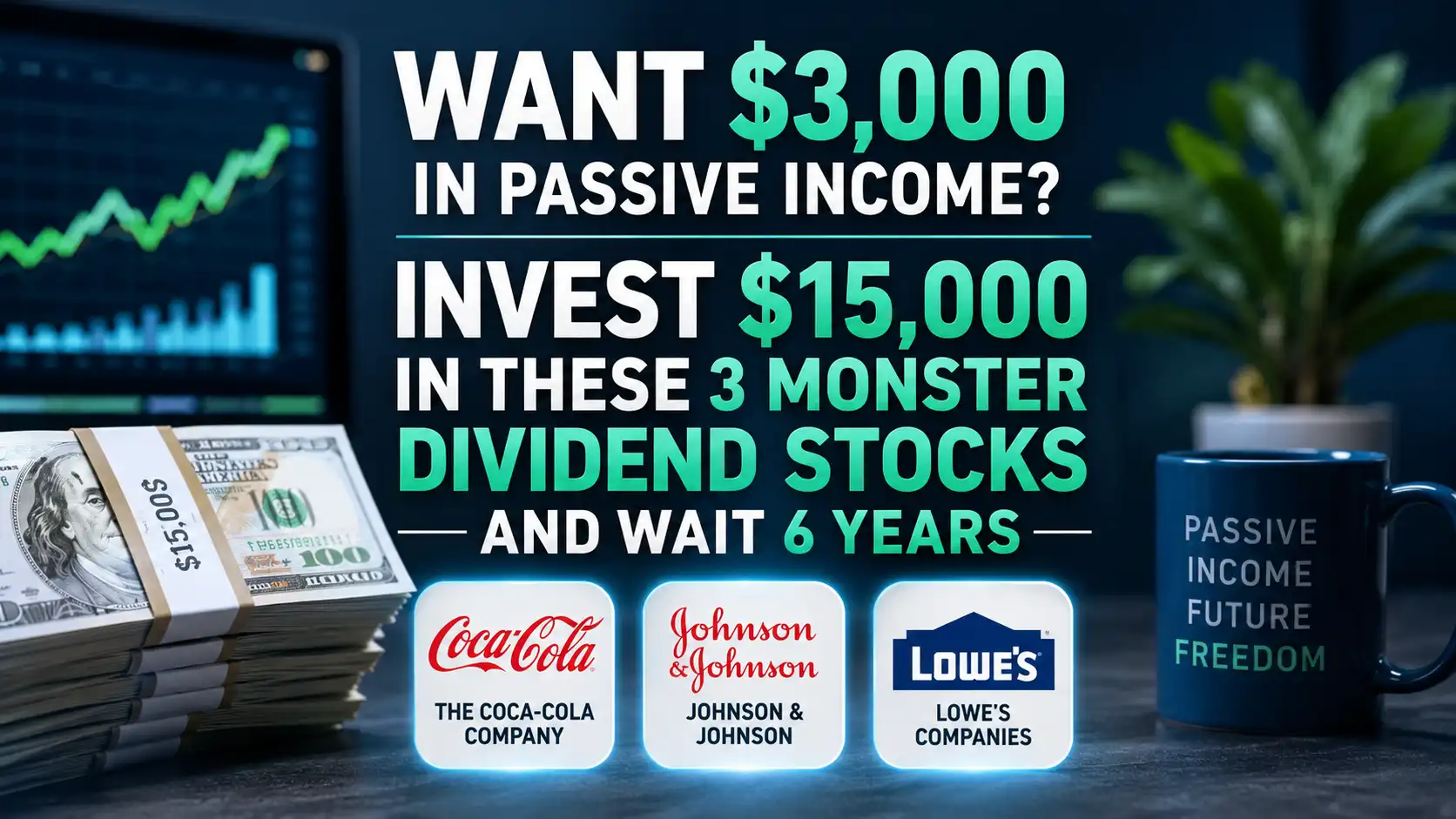
So, can investing $15,000 in three dividend growth stocks really help an investor work toward $3,000 a year in passive income over the next six years? The honest answer is: possibly as a long-term stepping stone, but probably not from dividends alone without strong compounding, portfolio growth, or additional contributions. That makes this a smart wealth building exercise—not a get-rich-quick formula.
Dividend Investing Fundamentals
What Are Dividends?
Dividends are cash payments that companies distribute to shareholders. If you own dividend-paying stocks, you may receive quarterly or monthly cash simply for holding your shares. For investors seeking financial freedom, that cash flow can become the foundation of a long-term dividend income strategy.
How Dividend Stocks Generate Passive Income
When you buy dividend stocks, you own a small piece of a business. If that business earns profits and its board approves a dividend, you receive your share of those payouts. Over time, that can create a stream of passive income that grows as the company raises its dividend or as you buy more shares.
Dividend Yield vs. Dividend Growth
Two concepts matter most in dividend investing:
- Dividend yield tells you how much income a stock pays relative to its share price.
- Dividend growth tells you how quickly that payout is increasing over time.
A stock with a high yield may produce more income today, but a stock with strong dividend growth may build more income over the long run. The best long-term investing candidates often balance both.
Why Dividend Reinvestment Matters
For most investors, especially younger professionals and early-stage savers, the real engine of wealth building is dividend reinvestment. Instead of spending the cash, you use it to buy more shares. Those extra shares can then produce even more dividends, creating a compounding loop that can steadily accelerate income growth.
Can $15,000 Really Generate $3,000 in Passive Income?
The Short Answer
If the goal is $3,000 annually, that equals $250 per month in passive income. On a $15,000 starting investment, that would require a 20% yield on original cost by year six.
That is a very aggressive target for a portfolio built around established, high-quality dividend stocks. A more realistic expectation is that $15,000 invested today in strong dividend names could produce several hundred dollars in annual income initially, then grow meaningfully through dividend hikes and reinvestment.
Required Return Math
Here is the reality check:
- At a 4% portfolio yield, you would need about $75,000 invested to generate $3,000 annually.
- At a 5% yield, you would need about $60,000 invested.
- Starting from $15,000, reaching that income level in six years without adding more capital would require exceptional total returns, unusually high yield-on-cost growth, or both.
That does not make the strategy bad. It simply means investors should frame this as a long-term stock market investing plan rather than a short-term income shortcut.
Growth Assumptions and Compounding
If your portfolio starts with a yield in the 3% to 4% range and the underlying companies increase their payouts by roughly 4% to 6% a year, your income can compound faster if you reinvest every dividend. In a favorable scenario, annual income might grow at a high-single-digit pace. That is powerful—but still far below the jump needed to turn $15,000 into $3,000 a year in only six years.
The 3 Featured Dividend Stocks
1) Johnson & Johnson (NYSE: JNJ)
Company Overview and Business Model
Johnson & Johnson is one of the world’s largest healthcare companies, operating across Innovative Medicine and MedTech. That diversification matters because it gives investors exposure to both pharmaceuticals and medical devices rather than relying on a single product line. Source
Competitive Advantages
JNJ’s core strengths are scale, global reach, and resilience. Healthcare demand tends to be steadier than demand in many cyclical industries, and its broad product mix can help offset weakness in any one area. That makes it a classic candidate for retirement income and conservative dividend investing.
Dividend History and Growth Record
In April 2026, Johnson & Johnson announced its 64th consecutive year of dividend increases, raising the quarterly dividend 3.1%, from $1.30 to $1.34 per share, for an indicated annual rate of $5.36 per share. Koyfin lists the stock’s dividend yield at 2.25% and its payout ratio at 59.52%, with 5-year dividend growth of 5.18%. Source Source
Financial Strength
For fiscal 2024, Johnson & Johnson reported $88.821 billion in revenue, $24.266 billion in operating cash flow, and about $11.823 billion in dividend payments. That cash-generation profile suggests solid dividend coverage and helps explain why JNJ remains a staple among high-quality dividend stocks.
Future Growth Prospects
Future growth likely depends on product innovation, pipeline execution, and continued strength in medical technology. JNJ may not be the fastest-growing stock, but its combination of durability and income reliability is exactly why many long-term investors keep it on their watch list.
Potential Risks
The biggest risks include patent expirations, litigation, regulatory pressure, and slower-than-expected drug or device growth. JNJ is sturdy, not risk-free.
2) The Coca-Cola Company (NYSE: KO)
Company Overview and Business Model
Coca-Cola describes itself as a total beverage company with products sold in more than 200 countries and territories. Its portfolio spans sparkling soft drinks, water, sports drinks, coffee, tea, juice, dairy, and plant-based beverages. That kind of global brand reach is a major competitive advantage. Source
Competitive Advantages
KO’s edge is brand power, distribution scale, and repeat consumer demand. Many of its products are everyday purchases, which helps support stable cash flow. For investors focused on wealth accumulation strategies, that kind of consistency can be valuable.
Dividend History and Growth Record
In February 2026, Coca-Cola approved its 64th consecutive annual dividend increase, lifting the quarterly payout about 4%, from $0.51 to $0.53 per share, or $2.12 annually. Koyfin lists Coca-Cola’s dividend yield at 2.54%, its payout ratio at 80.07%, and its 5-year dividend growth rate at 4.54%. Source Source
Financial Strength
For 2024, Coca-Cola reported $47.061 billion in revenue, $10.631 billion in net income, and $6.805 billion in operating cash flow, while paying $8.359 billion in dividends. That makes KO attractive for income, but it also shows investors should watch dividend coverage and payout discipline more closely than they might with a lower-payout company.
Future Growth Prospects
Coca-Cola’s growth story is less about explosive expansion and more about pricing power, international scale, premiumization, and broadening its beverage lineup. That is often enough to support steady dividend hikes.
Potential Risks
Key risks include slower consumer demand, foreign exchange pressure, commodity costs, changing health preferences, and the fact that its payout ratio is already on the higher side.
3) Realty Income (NYSE: O)
Company Overview and Business Model
Realty Income is structured as a REIT and focuses on freestanding commercial properties leased under long-term net lease agreements. Macrotrends says the company has a portfolio of more than 11,000 properties, while Realty Income emphasizes its mission of delivering dependable monthly passive income through recurring dividends. Source Source
Competitive Advantages
Realty Income stands out because it pays monthly rather than quarterly dividends, an attractive feature for passive income seekers. Its scale, tenant diversification, and long lease structures also give investors more visibility than many smaller real estate names.
Dividend History and Growth Record
Realty Income says it has declared 672 consecutive monthly dividends, delivered 115 consecutive quarterly increases, and produced a 4.1% compound annual dividend growth rate since its 1994 NYSE listing. Macrotrends reports a current trailing annual dividend payout of $3.25 and a dividend yield of 5.09% as of June 11, 2026. Source Source
Financial Strength
For 2024, Realty Income reported $5.271 billion in revenue, $3.573 billion in operating cash flow, and $2.692 billion in common dividends paid. It also disclosed nearly $49.382 billion in future lease payments to be received, giving investors a useful measure of cash-flow visibility.
Future Growth Prospects
An official 2026 investor-relations release summarized by search results said Realty Income’s adjusted funds from operations (AFFO) per share increased 6.6% to $1.13 in the first quarter of 2026. That matters because REIT investors often look at AFFO, not EPS, when judging dividend sustainability. Source
Potential Risks
The biggest risks are interest-rate sensitivity, tenant issues, recession pressure on commercial real estate, and the need to keep funding acquisitions efficiently.
Why These Dividend Stocks Stand Out
These three names offer a useful mix for a beginner-friendly passive income portfolio:
- Johnson & Johnson brings healthcare stability and moderate dividend growth.
- Coca-Cola adds consumer-defensive cash flow and brand strength.
- Realty Income provides a higher yield and monthly distributions.
Key Metrics Snapshot
| Stock | Dividend Yield | Annual Dividend | Payout Metric | Notable Strength |
| Johnson & Johnson | 2.25% | $5.36 | 59.52% payout ratio | Strong cash flow, 64 straight annual raises |
| Coca-Cola | 2.54% | $2.12 | 80.07% payout ratio | Global brand, 64 straight annual raises |
| Realty Income | 5.09% | $3.25 | REITs are better judged by AFFO/OCF coverage | Monthly dividends, 672 consecutive monthly payouts |
From a dividend safety standpoint, JNJ appears the most conservatively covered by cash flow. KO remains dependable, but its higher payout ratio deserves monitoring. Realty Income offers the highest starting yield, but REITs are more sensitive to interest rates and financing conditions.
Hypothetical Portfolio Allocations
Using the cited dividend yields above, here is how a $15,000 portfolio might look today.
1) Equal-Weight Strategy
- $5,000 JNJ
- $5,000 KO
- $5,000 O
Estimated starting annual income:
- JNJ: about $113
- KO: about $127
- O: about $255
Total: about $494 per year or $41 per month
This is a balanced dividend investing approach for beginners who want diversification across healthcare, consumer staples, and real estate.
2) Growth-Focused Strategy
- $9,000 JNJ
- $3,000 KO
- $3,000 O
Estimated starting annual income: about $431
This approach lowers income today but leans more heavily toward JNJ’s balance of dividend safety and growth.
3) Income-Focused Strategy
- $9,000 O
- $3,000 JNJ
- $3,000 KO
Estimated starting annual income: about $602 or roughly $50 per month
This version pushes for higher upfront passive income, but it also increases exposure to REIT-specific and interest-rate risk.
The Power of Dividend Reinvestment
If you reinvest every payout, your dividends start buying additional shares automatically. Those new shares create more future income, and when companies raise their dividends, each share becomes even more productive.
A realistic six-year outcome for this $15,000 portfolio might look something like this:
- Equal-weight portfolio: income grows from roughly $494 to around $750 to $850 annually
- Growth-focused portfolio: income rises from about $431 to roughly $650 to $750 annually
- Income-focused portfolio: income grows from about $602 to around $850 to $1,000 annually
These are not guarantees. They assume dividend growth continues, dividends are reinvested, and there are no major cuts or tax drag. But they show how dividend reinvestment can materially improve results over a six-year window.
Risks Every Dividend Investor Should Understand
Dividend investing is powerful, but it is not risk-free.
Market Volatility
Even the best dividend growth stocks can fall sharply during market sell-offs. Share prices and dividend income are not the same thing, but volatility can still test investor discipline.
Dividend Cuts
A company can reduce or suspend its dividend if earnings weaken, debt rises, or business conditions deteriorate.
Economic Downturns
Recessions can affect consumer spending, healthcare budgets, real estate occupancy, and financing conditions.
Interest Rate Changes
Rising rates often pressure REITs and other income-oriented sectors because investors can suddenly find more competition from bonds and cash instruments.
Company-Specific Risk
A strong brand or long dividend history does not eliminate problems like litigation, weak execution, regulatory changes, or management missteps.
Dividend Investing vs. Other Income and Growth Options
Growth Stocks
Growth stocks can offer higher total return potential, but usually produce little or no current income. They may suit investors prioritizing wealth accumulation over near-term cash flow.
Bonds
Bonds offer more predictable income, but their growth potential is limited, and inflation can erode real returns.
REITs
REITs often provide higher yields than traditional stocks, making them attractive for retirement income, but they can be more rate-sensitive.
Index Funds
Index funds are excellent for broad diversification and simple long-term investing, though many investors combine them with individual dividend stocks to create a more intentional passive income portfolio.
How to Build a Sustainable Passive Income Portfolio
Diversify Across Sectors
Avoid relying on one industry. Healthcare, consumer staples, utilities, financials, industrials, and REITs all play different roles.
Think Long Term
The best dividend strategies usually reward patience. Six years is helpful, but the real magic often shows up over 10, 15, or 20 years.
Monitor the Business, Not Just the Yield
A high yield can be attractive, but yield alone is not safety. Watch payout ratios, balance sheets, cash flow, and earnings quality.
Understand Taxes
Qualified dividends, REIT dividends, and retirement accounts can all have different tax implications. Investors should understand how their account type affects after-tax income.
Reinvest Strategically
Automatic reinvestment is powerful early on. Later, investors can choose to direct dividends into whichever holdings appear most attractively valued.
Expert Perspective: What This Strategy Really Offers
The best way to think about this $15,000 plan is not as an instant path to financial freedom, but as a practical entry point into disciplined stock market investing.
A portfolio built around Johnson & Johnson, Coca-Cola, and Realty Income offers three important things:
- Current income
- Potential dividend growth
- A framework for long-term wealth building
For retirement planners, the bigger lesson is that sustainable passive income is usually built from a combination of:
- quality businesses,
- reinvested income,
- time,
- diversification,
- and often additional savings contributions.
Key Takeaways
- Dividend stocks can be an effective source of passive income, especially for beginners and long-term investors.
- A $15,000 portfolio in JNJ, KO, and Realty Income would likely start closer to $430 to $600 in annual income, depending on allocation.
- Reinvestment and dividend growth can meaningfully increase that income over six years.
- Reaching $3,000 annually from $15,000 alone in just six years is ambitious and probably unrealistic without unusually strong returns or additional capital.
- A disciplined dividend income strategy can still be a powerful tool for wealth building and future retirement income.
Future Outlook
Looking ahead, these three companies each offer different strengths:
- Johnson & Johnson remains a defensive healthcare compounder with strong cash generation.
- Coca-Cola continues to benefit from brand power and global beverage scale.
- Realty Income offers one of the market’s most recognizable monthly dividend models, with a long record of increases.
If dividend growth stays intact and investors continue reinvesting, this trio could help build a stronger income base over time. More importantly, it can teach new investors the habits that matter most: patience, diversification, and realistic expectations.
Conclusion
So, can investing $15,000 today in three monster dividend stocks realistically help investors reach meaningful passive income goals over the next six years?
Yes—but with the right expectations.
If the expectation is a fully formed $3,000-a-year passive income stream from dividends alone in six years, that target looks too aggressive for a conservative, high-quality dividend portfolio. But if the goal is to start building a durable passive income portfolio, learn the discipline of dividend reinvestment, and create a foundation for larger future income, then this strategy makes a lot of sense.
In other words, $15,000 may not instantly buy financial freedom. But invested thoughtfully in high-quality dividend stocks, it can absolutely help build the habits, cash flow, and compounding base that make long-term wealth possible.
