
Table of Contents
Key takeaways
- Federal Judge Tanya Chutkan issued a temporary restraining order barring any construction on Trump’s proposed 250-foot Triumphal Arch for 14 days.
- The order came less than two hours after the National Capital Planning Commission (NCPC) approved the project 8–4.
- The arch would sit at Memorial Circle, on the bridge corridor linking the Lincoln Memorial to Arlington National Cemetery.
- D.C. and Virginia sought the halt; veterans, lawmakers, and residents also oppose the plan.
- Administration officials framed the project as a national-security facility; critics call that justification thin and say Congress never approved it.
A federal judge has temporarily stopped work on President Trump’s proposed 250-foot Triumphal Arch near Arlington National Cemetery. According to NPR, U.S. District Judge Tanya Chutkan issued the order just before midnight (made public early Nov. 6, 2026), barring construction for 14 days after D.C. and Virginia asked the court to intervene.
The pause landed almost immediately after planners green-lit the monument. That timing—and the fight over whether the arch is a patriotic gateway or an unauthorized vanity project—now sits at the center of a fast-moving legal and political battle in the capital.
What Judge Chutkan ordered
Chutkan’s temporary restraining order stops the administration from starting construction for two weeks. A Bloomberg Law summary of the order says the ban covers initiating construction, excavation, demolition, land disturbance, utility installation, roadway closure, or other construction-related activity.
NPR reported that the 33-page opinion scrutinized the administration’s national-security justification and found that local governments were likely to be harmed if work began right away. NBC News noted that D.C. and Virginia sought the TRO because the administration expected construction to begin immediately.
The ruling arrived less than two hours after the NCPC’s 8–4 approval, NPR said. Government lawyers had already been told to notify the court within an hour of any approval, after earlier lawsuits were consolidated before Chutkan.
Where the arch would go—and what it would look like
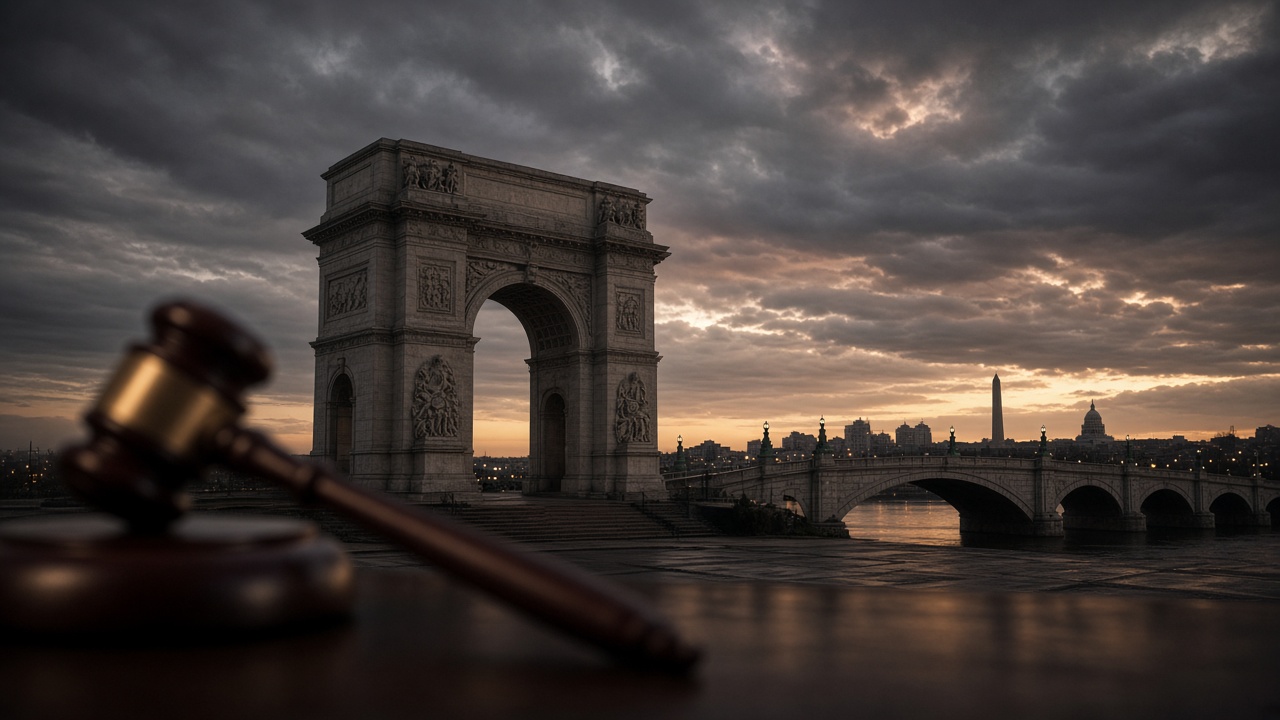
The proposed arch would rise about 250 feet (72 meters) at Memorial Circle, a traffic island on the bridge linking the Lincoln Memorial to Arlington National Cemetery, NPR and the BBC reported. Critics have nicknamed it the “Arc de Trump.”
According to the BBC, renderings show a golden winged Lady Liberty on top, gold eagles, and the phrases “One Nation Under God” and “Liberty and Justice for All.” The administration has tied the monument to the nation’s 250th anniversary.
Officials have said construction would run roughly 20 hours a day, year-round, for two to three years, NPR reported. White paint lines were already visible on the grass; government lawyers told the court that a construction firm painted them on Saturday without National Park Service authorization.
How the NCPC vote unfolded
The NCPC approved the project 8–4 after nearly eight to nine hours of public testimony in a virtual meeting held because of high demand, NPR reported. About 131 people signed up to speak, and the livestream crashed early. A motion by D.C. Council Chair Phil Mendelson to postpone failed 4–8. Vice Chair Stuart Levenbach said the proponent was under a time constraint and wanted a decision that day.
NBC News noted that all four opposing votes came from non-Trump appointees. NCPC Chair Mark Paoletta argued it is important to display national identity through grand monuments and that the gateway to Arlington deserves such a statement, the BBC reported.
Outside the commission, preservation and watchdog voices were sharper. Brent Leggs of the National Trust called the vote a “sham.” Jimi Shaughnessy of the National Parks Conservation Association said the fight should go to Congress and that the arch should never be built. Robert Weissman of Public Citizen said Congress never approved the project, that courts will decide the immediate question, and that Congress can still block it, NPR reported.
Why supporters say the arch is needed
The administration has argued that Congress authorized a related concept through a 1925 plan for a pair of 166-foot columns that were never built, NPR reported. Officials also lean on national-security claims. Interior official Greg Wischer said the arch would serve specific national-security functions under seal. At the same time, the National Park Service has said it “has not been privy to any national defense preparations.”
The BBC reported that the administration says the arch would double as a complex to store military equipment and house snipers and drones. On Truth Social, Trump argued there is no facility like this and that Washington is the only capital without a triumphal arch. Paoletta framed the monument as a statement of national identity at a symbolic gateway.
Those national-security arguments are exactly what Chutkan’s opinion examined closely—and what opponents say do not justify rushing excavation beside Arlington.
Why veterans, neighbors, and lawmakers object
Opposition has been intense. Veterans, lawmakers, and residents warned the arch would obstruct views, insult service members buried at Arlington, raise D.C. airspace risks, raise legality questions, and proceed with an unconfirmed cost, NPR reported.
Vietnam War veterans and an architectural historian sued earlier; D.C. and Virginia sued last weekend. Chutkan consolidated the cases.
Veteran Anne Wright said the project is tied to bulldozers and argued that voters in the midterms rejected a politics of war and ego, the BBC reported—a debate that also runs through coverage of the 2026 midterm election results and Election Day 2026 poll closings and results. Veteran John Pomeroy said the arch lessens the solemn nature of a cemetery visit and called military storage there “silly” and a potential target for attacks.
Rep. Don Beyer (D-Va.) called the court order a critical first step and said his bill to prohibit or defund the project should grow from about 80 cosponsors to 200 or more. Rep. Jared Huffman (D-Calif.) warned that officials and firms advancing an unauthorized project face legal risk and said he expects to lead Natural Resources Committee scrutiny; he also argued the arch fractures a view meant for unity and sacrifice and functions as a tribute to Trump, NPR and the BBC reported.
The arch fight is not the only Trump-era building dispute in Washington. The BBC noted that the roughly $400 million White House ballroom project and a so-called “trash island” golf course plan have also drawn legal challenges—part of a broader climate of contested federal projects that also includes energy and tech fights such as OpenAI’s data-center power pledge.
What happens next
The TRO lasts 14 days. In that window, the administration cannot break ground, dig, close roads, or take other construction steps. Courts will hear further argument; Congress may move to prohibit or defund the project; and the NCPC’s approval remains politically contested even after the 8–4 vote.
For now, the paint lines on the grass are a reminder of how close work appeared to starting—and how quickly Judge Chutkan stopped it.
FAQ
Did a judge permanently kill the Trump Triumphal Arch?
No. Judge Tanya Chutkan issued a temporary restraining order for 14 days. It pauses construction-related activity while the legal fight continues; it is not a final ruling on whether the arch can ever be built.
What did the National Capital Planning Commission decide?
The NCPC approved the 250-foot arch proposal 8–4 after a lengthy virtual hearing with extensive public testimony. All four “no” votes came from non-Trump appointees, according to NBC News.
Where would the arch be built?
At Memorial Circle, on the traffic island along the bridge corridor between the Lincoln Memorial and Arlington National Cemetery—an area critics say is sacred ground for remembrance, not a construction zone for a monumental arch.
Why do supporters claim national security?
Administration officials say the structure could store military equipment and support sealed national-security functions, including snipers and drones. Critics, and parts of the Park Service’s own statements about not being privy to defense preparations, dispute whether that justification supports immediate construction.
Can Congress still stop the project?
Yes. Lawmakers including Rep. Don Beyer have introduced efforts to prohibit or defund the arch, and advocates say Congress never approved this version of the monument. The courts and Congress can both shape what happens after the 14-day pause.