
Table of Contents
By Sam | Updated November 10, 2026. A current explainer on how robots learn from watching people, based on recent research papers and announcements from New York University and Google DeepMind.
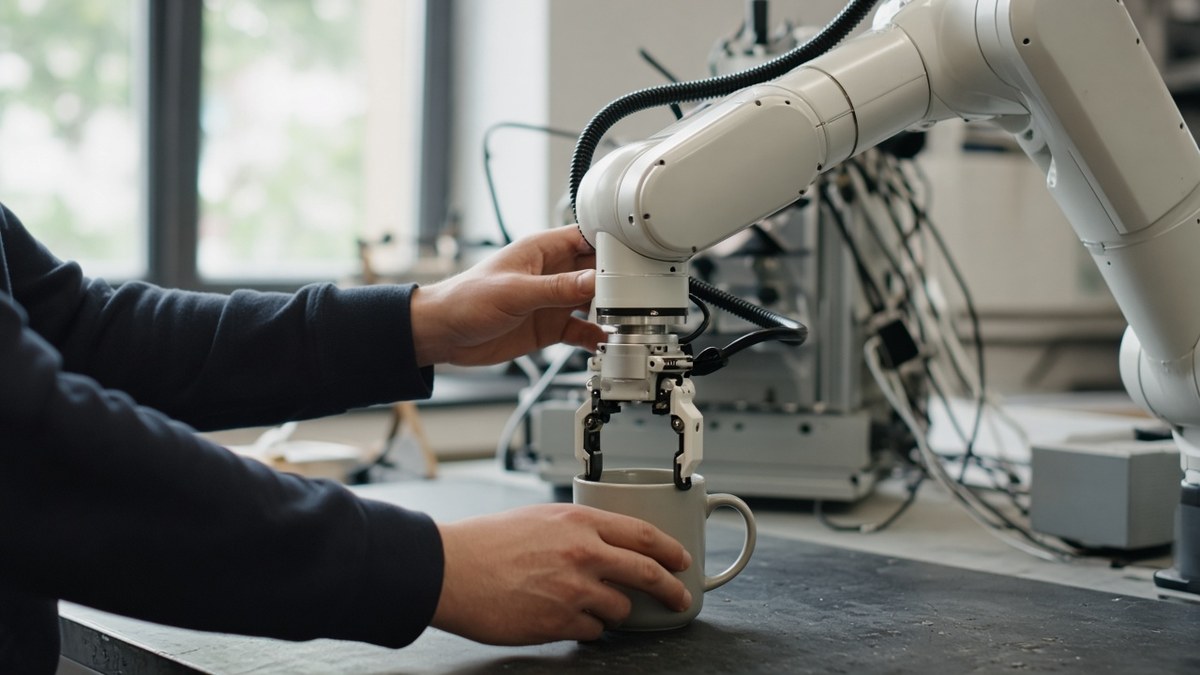
Teaching a robot a new chore used to mean hundreds or thousands of carefully recorded examples, often with a person remote-controlling the machine. Researchers are now cutting that down dramatically. In an October 2026 preprint, a team at New York University reported a system that lets a robot learn a new task in a new home from just five human demonstrations in under five minutes, recorded by a person wearing smart glasses. Here is how this kind of learning works, what it can and cannot do yet, and why it matters.
Key takeaways
- Traditional behavior cloning needs hundreds, if not thousands, of demonstrations per task.
- NYU’s Steertuning system learned 12 new tasks in 12 new environments from five human videos each, with a 71% average success rate.
- Its approach combines a model pretrained on about 100 hours of everyday human activity with a two-minute fine-tune.
- Google DeepMind’s Gemini Robotics models aim for general, interactive and dexterous robots that handle tasks they never saw in training.
The old way: lots of robot data
The standard technique, called behavior cloning, records a robot being teleoperated through a task many times and trains a model to copy those movements. The NYU researchers note this “requires hundreds, if not thousands, of demonstrations per task.” Pretraining on very large robot datasets and then fine-tuning helps, but for big models that adaptation can still take days.
The new way: learning from human video
People are far easier to record than robots. The Steertuning paper from NYU’s Lerrel Pinto and colleagues uses Meta’s Aria Gen 2 research glasses, which capture video, depth, head position and detailed hand tracking as a person goes about daily life.
| Step | What happens |
|---|---|
| 1. Pretraining | A 400-million-parameter diffusion policy learns from about 100 hours of everyday human activity such as cooking, dishwashing and cleaning |
| 2. Five demos | A person wearing the glasses performs the new task five times |
| 3. Quick fine-tune | The model is adapted for about two minutes (2,000 updates) |
| 4. Steering | While acting, the robot nudges its movements toward the demonstration that best matches the scene in front of it |
To bridge the gap between human and robot bodies, the system removes both the human’s arms and the robot’s arms from what the model sees, so it focuses on the scene and objects. Test tasks included picking up trash or bread and dropping it into a container, and watering a flower, with nine tasks tested in a rented Airbnb and three in the lab.
How well it worked
| Method (three lab tasks) | Average success |
|---|---|
| Steertuning (2-minute fine-tune + steering) | 8.3 / 10 |
| Full fine-tune (about a day of training) | 7.7 / 10 |
| Steering only | 2.3 / 10 |
| Short fine-tune only | 0 / 10 |
The key result is that the quick combination matched or beat a much slower full fine-tune. The robot also handled some new objects as long as the required action was similar to what it had been shown. The team also connected the system to navigation software and a Gemini model that splits a spoken command, such as “Put the white cup into the trash,” into steps: go to the cup, pick it up, go to the trash and drop it.
Big tech’s approach: general robot models
Google DeepMind introduced Gemini Robotics in March 2025, a vision-language-action model built on Gemini 2.0 that outputs physical actions. DeepMind said it can generalize to new objects, instructions and environments, more than doubling performance on a generalization benchmark versus other leading models, and can do dexterous tasks like folding origami. Its companion model, Gemini Robotics-ER, can use in-context learning to follow “the patterns of a handful of human demonstrations.” DeepMind partnered with Apptronik on humanoid robots and named testers including Agile Robots, Agility Robots, Boston Dynamics and Enchanted Tools.
Limits and open problems
- No sense of touch in video. The NYU team notes human video contains no contact information, which limits dexterity.
- Body differences. Mapping human hand motions onto robot hands can fail even when the prediction is correct.
- Success is not yet reliable enough for most homes; 71% means roughly three failures in ten tries.
- Safety. DeepMind says it layers physical safety controls with semantic checks on whether an action is safe.
Why it matters
If robots can learn from a few minutes of human video, training could move from specialist labs to ordinary homes and workplaces. That could speed up household and warehouse robots, but it also raises questions about jobs, privacy from always-on cameras, and safety around people. For how AI is reshaping work, see our guide to AI side hustles and our coverage of AI data centers and power.
FAQ
Can robots learn by watching humans?
Yes. Research systems such as NYU’s Steertuning learn new tasks from a handful of human videos.
How many demonstrations does a robot need?
Traditional methods need hundreds or thousands; Steertuning used five per task.
Are these robots in homes yet?
Mostly not. These are research results with success rates that still fall short of everyday reliability.
What is a vision-language-action model?
An AI model that takes in images and language instructions and outputs robot actions, like Google DeepMind’s Gemini Robotics.
Sources: Steertuning Policies from a Few Human Videos (arXiv, 2026); Google DeepMind: Gemini Robotics (March 12, 2025).