
Table of Contents
By Sam | Updated November 10, 2026. A current explainer using the latest UN food security data (SOFI 2026) and the IPCC’s assessment of climate impacts on food.
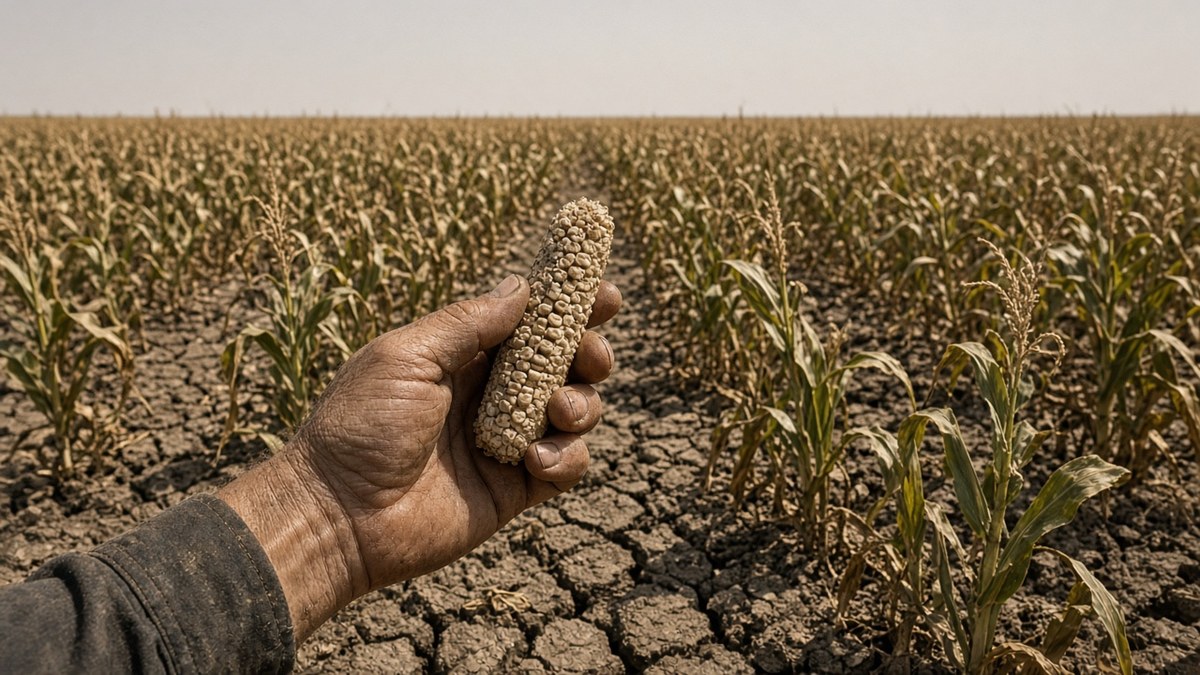
The world grows more food than ever, yet the systems that feed us are highly exposed to heat, drought, floods and shifting seasons. Global hunger has fallen for three years in a row, according to the UN Food and Agriculture Organization (FAO), but scientists warn those gains are fragile in a warming world. Here are five data points, presented as simple tables, that explain why our food system is not yet ready for the climate crisis, and what can make it more resilient.
Key takeaways
- An estimated 645 million people (7.8% of the world) faced hunger in 2025, FAO says, down from the 2022 peak.
- About 520 million people could still face hunger in 2030, keeping the world off track for Zero Hunger.
- The IPCC says climate change has slowed global agricultural productivity growth over the past 50 years.
- Above 1.5°C of warming, the risk of simultaneous maize failures in major producing regions rises.
1. Hunger is falling, but slowly
| Measure (2025) | Figure |
|---|---|
| People facing hunger | ~645 million (7.8% of population) |
| Change vs 2024 | Nearly 14 million fewer |
| Change vs 2022 peak | 43 million fewer |
| Moderate or severe food insecurity | ~2.1 billion people |
| Projected hunger in 2030 | ~520 million |
FAO’s Director-General QU Dongyu said the progress shows “hunger is not inevitable.” But FAO warned the 2030 projection may understate risks because it does not fully account for a strong El Niño or recent cuts in development and humanitarian funding.
2. Climate change is already slowing farm productivity
The Intergovernmental Panel on Climate Change (IPCC) concluded in its Sixth Assessment Report that, although overall agricultural productivity has increased, climate change has slowed this growth over the past 50 years globally. The negative effects were mainly in mid- and low-latitude regions, while some high-latitude regions saw gains. A 2021 study in Nature Climate Change by Ortiz-Bobea and colleagues estimated that human-caused climate change has reduced global agricultural total factor productivity by about 21% since 1961, equivalent to losing the last seven years of productivity growth, with larger losses of roughly 26–34% in warmer regions such as Africa and Latin America.
| Observed impact (IPCC AR6) | Where |
|---|---|
| Slower agricultural productivity growth | Mainly mid- and low-latitude regions |
| Lower shellfish aquaculture and fisheries output | Some ocean regions, due to warming and acidification |
| Millions exposed to acute food insecurity | Africa, Asia, Central and South America, Small Islands, the Arctic |
3. Risks rise with every increment of warming
| Warming level | IPCC assessment for food |
|---|---|
| 1.5°C–2°C | Food security risks in vulnerable regions rise from moderate to high with little adaptation |
| Above 1.5°C | Higher risk of simultaneous maize losses in major producing regions |
| 2°C or more | More severe risks, malnutrition and micronutrient deficiencies, concentrated in Sub-Saharan Africa, South Asia, Central and South America and Small Islands |
| 3°C or more | Areas exposed to climate hazards expand substantially, widening regional gaps |
The IPCC also warns that warming will weaken soil health and pollination, increase pressure from pests and diseases, and reduce marine animal biomass. Heat also cuts the productivity of outdoor farm workers. Together, these effects could raise food prices and lower household incomes.
4. Healthy diets are still out of reach for many
FAO says nearly one-third of the world’s population cannot afford a healthy diet. Nutritious foods such as fruit, vegetables and animal-source foods often remain expensive because costs build up across storage, processing, transport and retail. Weak cold chains, unreliable energy and poor infrastructure make these foods especially vulnerable to climate shocks, since heat and floods damage perishable goods and disrupt roads.
5. Africa is at a turning point
| Africa | 2024 | 2025 |
|---|---|---|
| Prevalence of hunger | 20.3% | 20.0% |
| Undernourished people | ~309 million (2025) | |
The small decline was the first break in Africa’s rising hunger trend since 2017, FAO said. But with rapid population growth, the number of hungry people could still rise. The IPCC identifies parts of Africa among global hotspots of high vulnerability to climate change.
What would make food systems ready
The IPCC lists effective adaptation options including improved crop varieties, agroforestry, community-based adaptation, farm and landscape diversification and urban agriculture. It also says reducing food loss and waste and supporting balanced diets bring benefits for nutrition, health and the environment. FAO’s priorities include keeping food and fertilizer markets open, avoiding export bans, protecting vulnerable people with social protection, and investing in irrigation, storage, cold chains and early-warning systems.
At home, you can help by cutting food waste; our guide to starting a low-waste lifestyle has practical steps. For the bigger picture on emissions, see why net zero by 2050 needs less consumption, and for access to healthy food in the U.S., read our explainer on food deserts and federal funding.
FAQ
How many people are hungry in 2026?
FAO’s 2026 report estimates about 645 million people faced hunger in 2025, 7.8% of the global population.
How does climate change affect crops?
More frequent heat, drought and floods reduce yields and disrupt supply; the IPCC says climate change has already slowed agricultural productivity growth.
Which regions are most at risk?
The IPCC highlights Sub-Saharan Africa, South Asia, Central and South America and Small Islands.
What can reduce the risk?
Climate-resilient crops, diversification, agroforestry, better storage and cold chains, less food waste and social protection.
Sources: FAO: SOFI 2026 launch (July 21, 2026); IPCC AR6 WGII Summary for Policymakers; Ortiz-Bobea et al., Nature Climate Change (2021).
