
Table of Contents
When a Kitchen Becomes a Cathedral
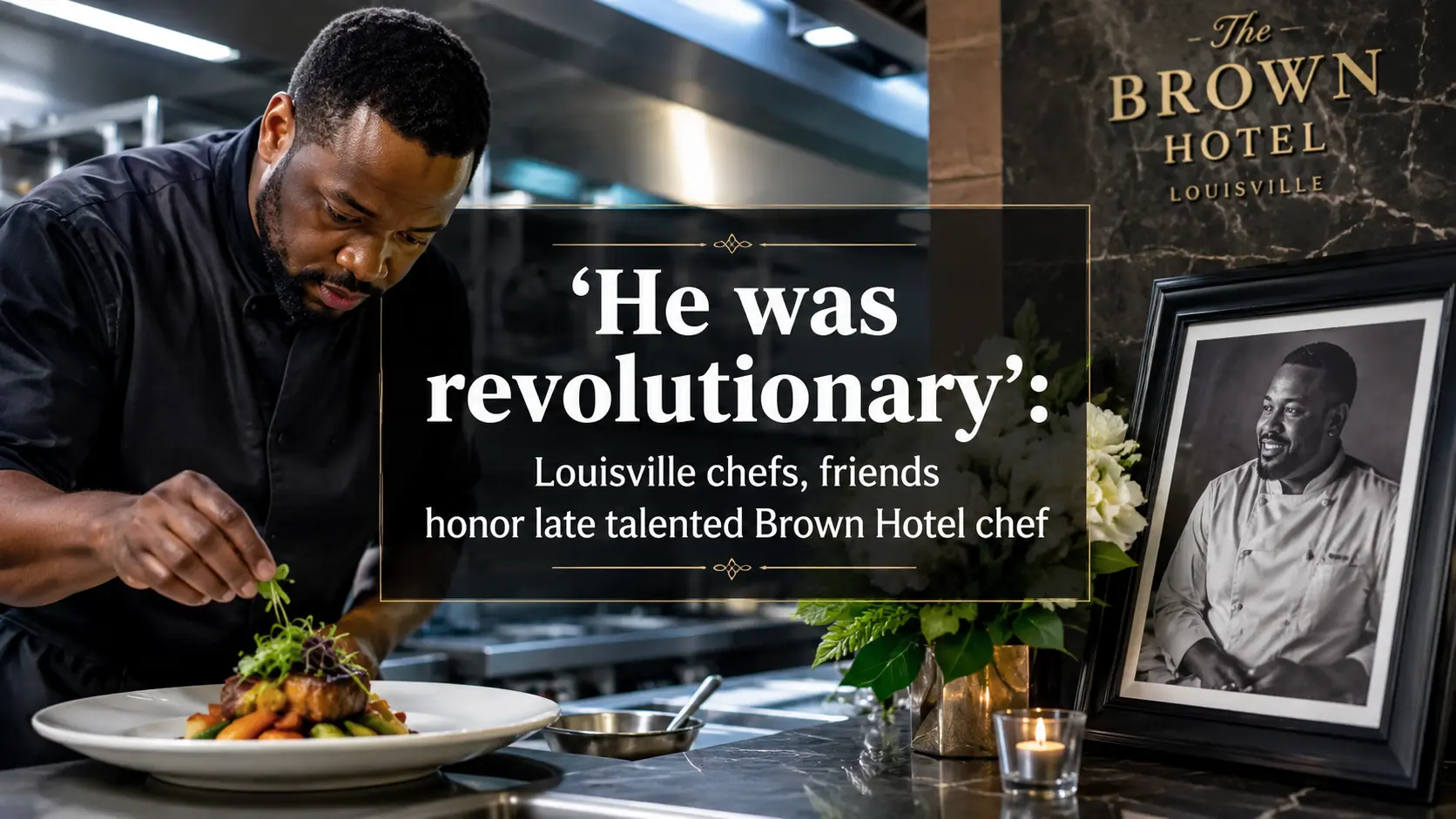
There is a certain kind of person who does not merely cook food — they transform it into memory, into identity, into love made tangible on a plate. In Louisville, Kentucky, a city long celebrated for its bourbon, bluegrass, and the thundering heartbeat of the Derby, there lived such a person. He stood behind the pass at The Brown Hotel, one of the most storied establishments in the American South, and turned every service into something that transcended the ordinary.
When news of his passing rippled through Louisville’s culinary community, the grief was swift and real. Chefs set down their knives. Line cooks held silence in their kitchens. Restaurateurs, food writers, and regulars who had sat at linen-draped tables and tasted his vision — they all paused, knowing that something irreplaceable had left the room.
“He was revolutionary,” said one longtime colleague, her voice carrying the weight of years working beside him. “Not in a loud or boastful way. In the way water changes stone — slow, patient, and permanent.”
This is the story of that chef: his rise through Louisville’s culinary ranks, his reign at one of Kentucky’s grandest kitchens, and the enduring legacy that continues to shape the city’s food culture long after his final shift.
A Life Shaped by Flavor: The Chef’s Career Journey
From Humble Beginnings to the Heart of Louisville
Like many great chefs, his journey began not in a professional kitchen, but in a family home where food was the language of love. Raised in Louisville, he learned early that a well-seasoned pot of beans or a properly rendered country ham could communicate things words often failed to express. Those early lessons — patience, respect for ingredients, the understanding that cooking is fundamentally an act of generosity — never left him.
He came up through the ranks the hard way, working prep stations, washing dishes, and absorbing every technique that crossed his path. He trained with discipline, sought mentors who pushed him, and eventually earned his way into some of the city’s finest kitchens. By the time Louisville’s culinary community was beginning to find its footing as a genuine destination for serious food, he was already one of its quiet architects.
His talent was not flashy. He did not cook for applause. He cooked because the work itself moved him, because he believed that a meal prepared with integrity and skill could lift a person’s entire day — could, in fact, change how they understood what it meant to be cared for.
The Brown Hotel: A Stage Worthy of His Vision
When he took his position at The Brown Hotel, he stepped into a legacy that demanded both reverence and imagination. The Brown, opened in 1923, is not simply a hotel — it is a Louisville institution, the birthplace of the famous Hot Brown sandwich, a destination woven into the social and cultural fabric of the city. To cook in that kitchen was to inherit a responsibility.
He accepted that responsibility and ran with it.
Under his leadership, The Brown Hotel’s kitchen became something greater than it had been before: a place where classical technique met Kentucky sensibility, where tradition was honored but never allowed to calcify into complacency. He understood that The Brown’s culinary identity needed to grow without losing what made it beloved, and he navigated that balance with extraordinary skill.
His menus reflected the region — local farms, seasonal produce, bourbon-infused preparations that felt neither gimmicky nor forced — while also demonstrating a broader culinary fluency that elevated every dish to something memorable. Guests who dined at The Brown during his tenure often spoke of meals they remembered for years: the way a sauce caught the light, the tenderness of a braise, the quiet perfection of a composed plate that looked almost too beautiful to disturb.
“Revolutionary” — What His Peers Truly Meant
Redefining What Kentucky Food Could Be
When Louisville chefs describe their late colleague as “revolutionary,” they are not reaching for hyperbole. They are reaching for precision.
For much of its history, Kentucky cuisine was underestimated — reduced in the national imagination to fried chicken and derby pie, stripped of its complexity and depth by those who had never sat at a proper Kentucky table. He refused to accept that diminishment. Long before farm-to-table became a marketing buzzword, he was building relationships with local producers, insisting on ingredients that told a story, and placing Kentucky’s food culture in conversation with the best traditions in American and European cooking.
“He made us all believe that what we were doing here mattered,” said a fellow Louisville chef who trained under him early in his career. “That our food, our region, our identity — it deserved the same respect as anything coming out of New York or Charleston or New Orleans. He didn’t just say it. He proved it every single night.”
A Leadership Style Built on Dignity and Demand
He led his kitchen not through fear, but through example. In an industry too long marked by a culture of abuse — screaming, humiliation, and a brutal hierarchy that ground young cooks into the floor — he chose a different model. He was demanding in the truest sense: he demanded excellence, demanded care, demanded that every member of his team show up fully and do the work with pride. But he also demanded that his kitchen be a place of dignity.
Cooks who worked under him describe a man who noticed things — who would stop during a busy service to correct a technique, not with contempt, but with the focused attention of someone who genuinely wanted you to get better. He remembered the names of every person on his team, knew their stories, asked about their families. He saw his kitchen not as a machine to be run, but as a community to be cultivated.
“There was no yelling,” recalled one former line cook, now an executive chef in her own right. “But you never wanted to disappoint him. His respect meant everything, and you worked your hardest to keep it. That’s a far more powerful form of leadership than fear ever was.”
A Mentor Who Built the Next Generation
Planting Seeds That Grew Into Careers
Perhaps the most lasting measure of any chef’s greatness is not the awards earned or the accolades received, but the careers their mentorship made possible. By that measure, his legacy is extraordinary.
Dozens of Louisville chefs — now running their own restaurants, leading hotel kitchens, teaching at culinary programs — trace the pivotal moments of their careers back to time spent under his guidance. He had an unusual gift for recognizing potential in young cooks who had not yet recognized it in themselves, and a willingness to invest in people who were still rough around the edges.
He gave stages to culinary students who had no connections. He promoted from within, trusting his team with responsibilities before they felt fully ready, because he believed that growth happens at the edge of comfort. He sent young cooks to stages in other cities, connected them with chefs in his network, wrote letters of recommendation with specificity and warmth.
“He told me I had something when I didn’t believe it yet,” said one chef now operating two celebrated Louisville restaurants. “I was twenty-three and scared and convinced I was in over my head. He sat me down and told me exactly what he saw in me. I still have the note he gave me on my last day working with him. I’ve never thrown it away.”
Culinary Innovation That Shaped Louisville’s Identity
His innovations were not about spectacle. He was not a chef who chased trends or deployed theatrical technique for its own sake. His culinary innovation was grounded in something more enduring: a deep curiosity about his region’s food traditions and a rigorous commitment to making them better.
He championed Kentucky’s agricultural heritage at a time when it was fashionable to look elsewhere. He worked with heirloom grain farmers before artisan milling became a movement. He insisted on whole-animal butchery when it was considered inefficient. He explored the African American culinary traditions that had quietly shaped Kentucky food for centuries and brought them into dignified visibility on his menus — a choice that was, in its own way, a political act of profound respect.
His Hot Brown — the dish The Brown Hotel made famous — was executed with such loving precision that food writers traveled to Louisville specifically to taste his version. He did not reinvent it. He perfected it, and in doing so, demonstrated his core philosophy: that honoring tradition and pursuing excellence are not competing impulses, but the same impulse expressed from different angles.
Lessons We Can Learn From His Legacy
The life of a great chef is, in many ways, a series of lessons available to anyone willing to look closely. His legacy offers several that extend well beyond the kitchen walls.
Excellence is a daily practice, not a destination. He never treated a shift as ordinary, never allowed the repetition of professional cooking to blunt his attention. He cooked the hundredth beef tenderloin with the same focus he brought to the first. That discipline — treating every task as worthy of full engagement — is a lesson for any profession.
Mentorship is not a favor; it is a responsibility. He understood that the knowledge and skill he had accumulated were not his alone to keep. They belonged, in some sense, to the next generation that would carry them forward. Investing in the people around you, sharing what you know generously and without ego, is how any craft survives and grows.
Dignity in the workplace is not a luxury. His kitchen proved that you can run a high-performing, world-class professional kitchen without cruelty. The culture he built — demanding but humane, rigorous but respectful — produced better food, lower turnover, and more loyal teams than fear-based models ever could.
Know your place, and honor it. He was a Louisville chef, a Kentucky chef, rooted in the land and traditions of a specific place. He did not try to be someone else or cook someone else’s food. That rootedness was the source of his originality, not a limitation on it.
Gratitude is an ingredient. People who worked with him remember that he was grateful — for good produce, for a well-run service, for a young cook who finally mastered a difficult technique. Gratitude kept his work alive and joyful in ways that ambition alone never could have.
How the Culinary Community Is Keeping His Memory Alive
Tributes Across Louisville’s Restaurant Scene
In the months since his passing, Louisville’s culinary community has moved with quiet determination to ensure that his memory does not fade into abstraction. Across the city, in kitchens both grand and humble, chefs have found ways to honor what he meant to them and to their craft.
Several restaurants have placed special dishes on their menus — preparations that carry his influence in their technique or spirit, noted on the menu with his name. These are not performances of grief, but genuine expressions of gratitude: a way of saying, through the language of food, that he is still present in the work.
The Brown Hotel has established a culinary scholarship in his name, offered annually to a Louisville student pursuing a career in the hospitality industry. The scholarship carries not just financial support, but a statement of values: that this community believes in investing in the next generation, as he always did.
A Living Curriculum in Louisville’s Culinary Schools
At culinary programs throughout the city, instructors who knew him personally have begun incorporating his story and philosophy into their curricula — not as mythology, but as practical instruction. His approach to local sourcing, his methods of kitchen leadership, his commitment to regional culinary identity: these are now taught as models worth studying and emulating.
“We tell our students about him not because he was perfect,” said one culinary educator, “but because he was purposeful. Every choice he made in that kitchen meant something. That’s what we want our students to understand — that cooking with intention is what separates the merely skilled from the truly great.”
The Ripple Effect: A Legacy That Keeps Moving
Perhaps most powerfully, his legacy lives in the careers of the people he shaped. Every restaurant his mentees open, every kitchen his former cooks lead, every young chef who receives the same patient investment he once gave — all of it is a continuation of his work. His influence does not diminish with time; it compounds.
Louisville’s culinary community is, in significant ways, more confident, more cohesive, and more ambitious because he was part of it. That confidence is now passed forward, one generation at a time.
Key Takeaways
- His career at The Brown Hotel elevated Louisville’s culinary identity and demonstrated that Kentucky food culture deserved national respect.
- He introduced a model of kitchen leadership rooted in dignity and demand rather than fear — a model that produced exceptional results and deep loyalty.
- His mentorship shaped dozens of careers, creating a ripple effect that continues to influence Louisville’s restaurant industry today.
- His culinary innovation was grounded in a deep respect for regional ingredients, African American food traditions, and Kentucky’s agricultural heritage.
- His legacy is being honored through scholarships, memorial menu items, and the living practices of the chefs he trained.
Conclusion: The Meal That Never Ends
There is a notion in certain food traditions that a great cook never truly leaves the table — that the flavors they gave us, the techniques they passed on, the care they modeled, continue nourishing us long after they are gone. In Louisville, that notion has found its proof.
He stood in his kitchen for years, serving the guests of The Brown Hotel and, through his mentorship, serving the entire Louisville culinary community. He did not seek fame, though fame found him in the quiet, durable way that genuine excellence always does. He sought instead to do the work well, to do it with love, to bring people into his kitchen and make them better, and to send them out into the world carrying something they could not have found anywhere else.
Passion without discipline is just noise. He had both — the burning care for his craft and the rigorous daily practice that gave that care shape and direction. Innovation without roots is just novelty. He had both — an understanding of where he came from and the courage to imagine where he could go.
The Brown Hotel still stands on West Broadway, its corridors filled with the history of Louisville. In its kitchen, the work continues. Younger chefs move through the same spaces where he once commanded, carrying techniques and habits and values that trace, in ways they may not always consciously recognize, back to him.
That is legacy: not a monument, but a living inheritance — passed from hand to hand, from kitchen to kitchen, from one generation of cooks to the next, like a flame carried carefully through the wind.
He was revolutionary. And the revolution continues.
Frequently Asked Questions (FAQ)
1. Why is The Brown Hotel significant to Louisville’s culinary history? The Brown Hotel, opened in 1923, is one of Louisville’s most iconic landmarks and the birthplace of the famous Hot Brown sandwich — an open-faced turkey and bacon sandwich smothered in Mornay sauce that became a beloved Kentucky staple. As one of the city’s premier hospitality destinations, the hotel has long been a symbol of Louisville’s culinary identity and a benchmark for fine dining in the region.
2. What made this chef’s leadership style different from typical kitchen culture? In an industry historically defined by harsh, hierarchical environments, he built his kitchen around dignity, mutual respect, and purposeful mentorship. He maintained exacting professional standards while treating every member of his team as a person worthy of investment and care. This approach not only produced exceptional food but also generated deep loyalty, low turnover, and a generation of culinary professionals who carried his values into their own careers.
3. How did he contribute to Kentucky’s culinary identity? He was among the first Louisville chefs to systematically champion local, seasonal, and heritage ingredients at a fine-dining level, long before farm-to-table became mainstream. He also brought visibility and respect to the African American culinary traditions that have always been foundational to Kentucky food culture, weaving those contributions into his menus with intentionality and reverence. His work helped establish Louisville and Kentucky as serious destinations for culinary travel.
4. What is the culinary scholarship established in his honor? The Brown Hotel culinary scholarship, established in his memory, provides annual financial support to Louisville students pursuing careers in the hospitality industry. Beyond its financial dimension, the scholarship reflects his lifelong commitment to mentorship and his belief that investing in the next generation of culinary professionals is one of the most important things an established chef can do. Recipients are selected not only on the basis of skill but on evidence of character and commitment to their community.
5. How can aspiring chefs learn from his legacy today? His legacy is accessible through multiple channels: the kitchens of Louisville chefs who trained under him and actively share his philosophy; culinary programs throughout the city that have incorporated his story and approach into their curricula; and the scholarship bearing his name, which connects recipients to his values and vision. More broadly, any aspiring chef can draw from his example by studying his commitment to regional identity, his model of dignified leadership, and his understanding that mentorship — giving generously what you have learned — is the deepest expression of professional mastery.
